Technical Details
TL;DR
ADAMnetworks has observed abuse of internet traffic that exploits shared hosting ecosystems, including ones that have mitigated domain fronting. This abuse permits connections that appear to go to a trusted domain (E.G.: whatismyipaddress.com) to actually connect to another domain (E.G.: evilsite.ai) that could be used for malicious intent. Equipped with this technique, such a connection can be used for C2, VPN, Proxy, or circumvention of network egress policy, unless mitigated. In the simple form, the detection gap appears when DNS decisions, edge IPs, SNI, Host headers, and CDN tenant routing are not correlated. The endpoint sees an allowed DNS lookup while the connection can complete against a different hosted name.
Terms
About the term Underminr
Conceptually inspired by a fictional supervillain who operates underground to tunnel beneath cities, rob banks, cause structural collapse, and generally sow chaos and destruction. Undermining is a military term tracing back to medieval times, when attackers would tunnel beneath castle walls and ignite fires or explosives to cause a structural collapse. This conceptually describes the intent of any adversary using the techniques detailed here.
Undermining
The use of the Underminr circumvention technique
SNI Deception
A TLS connection pattern where the client connects to a CDN edge IP obtained from one domain's DNS answer, but sends SNI for a different domain accepted by that same shared edge.
Domain Fronting
A legacy technique similar in outcome of Undermining but using different Tactics, Techniques and Procedures (TTPs)
Underminr Adversarial Impact
The Underminr vulnerability could be used for any or all of the following reasons in adversarial campaigns:
- ●Effective defense evasion of PDNS-based security
- ●Effective detection evasion (including when PDNS+Microsoft ZTDNS are both in use)
- ●Effective Persistence with impunity
- ●Unrestricted access to C2 connections for additional payloads, encryption, or destruction
- ●Data exfiltration for espionage, extortion, or intellectual property theft
- ●Greatly reduced efforts and resources required for launching adversarial campaigns
- ●AI-generated malware can easily defeat hardened security environments
- ●AI-orchestrated attacks can execute and scale to overwhelm security worldwide
Technical Background
About Domain Fronting
Domain Fronting is a circumvention technique that exploits how HTTPS connections and content delivery networks (CDNs) handle domain names in different protocol layers. In a standard HTTPS request, the Server Name Indication (SNI) extension in the TLS handshake and the visible connection target typically match the domain being accessed, allowing censors to block based on that name; however, domain fronting deliberately mismatches them by placing an allowed "front" domain (such as a popular CDN-hosted service like google.com or cloudflare.com) in the SNI and TLS certificate validation fields while embedding the true, potentially blocked target domain in the encrypted HTTP Host header inside the TLS tunnel. Because many CDNs used to route requests internally based on the Host header rather than the outer SNI, the request reached the intended hidden destination, while passive network observers – including censors – see only traffic to the reputable front domain, making indiscriminate blocking costly due to collateral damage to legitimate services.
By way of an illustration, here's how Domain Fronting used to work and is largely mitigated now:
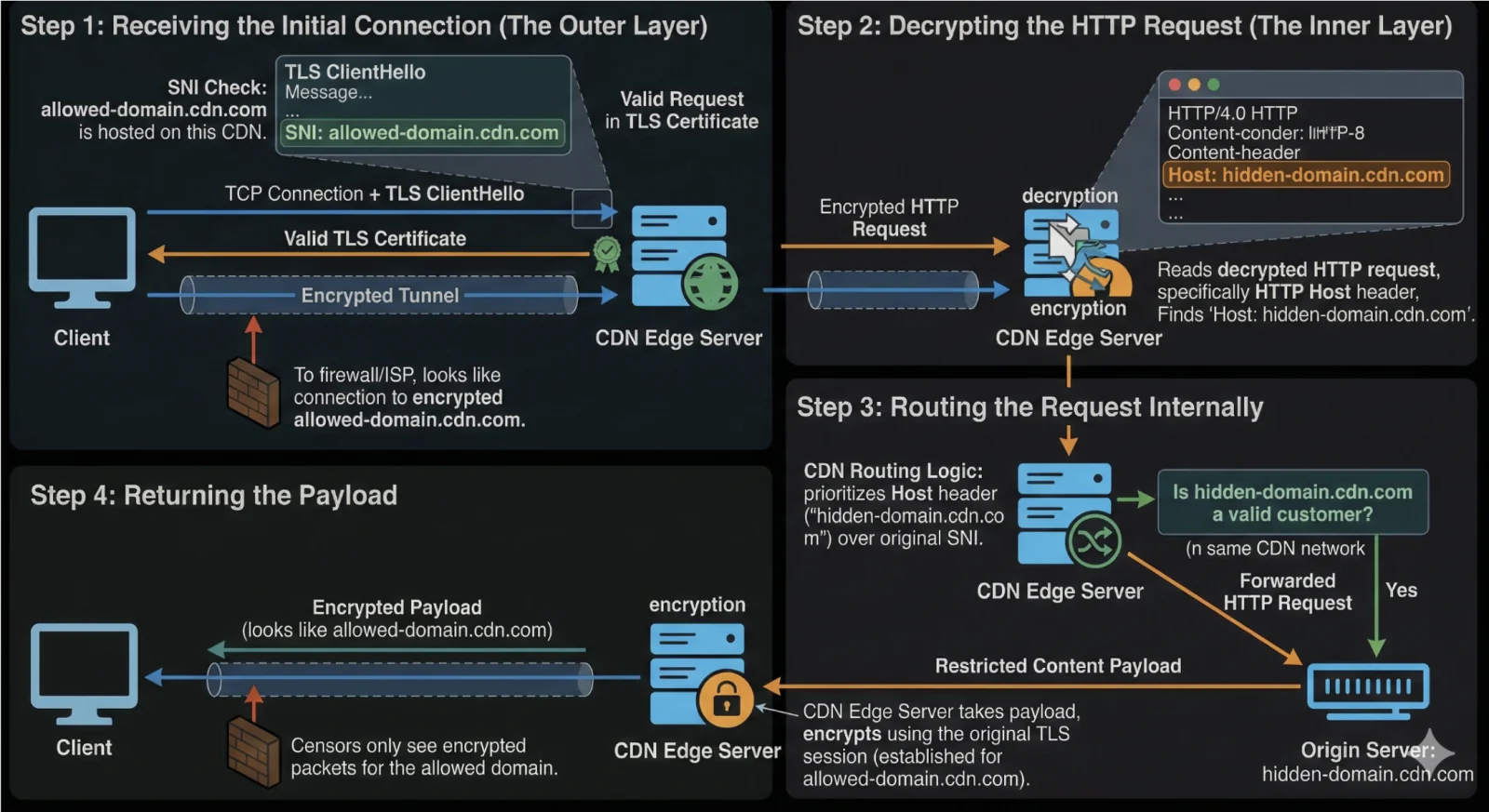
Major providers largely curtailed this legacy technique by 2018, which significantly reduced its viability. The shared-edge routing issue tested by Underminr is a different abuse path.
How Domain Fronting differs from Underminr
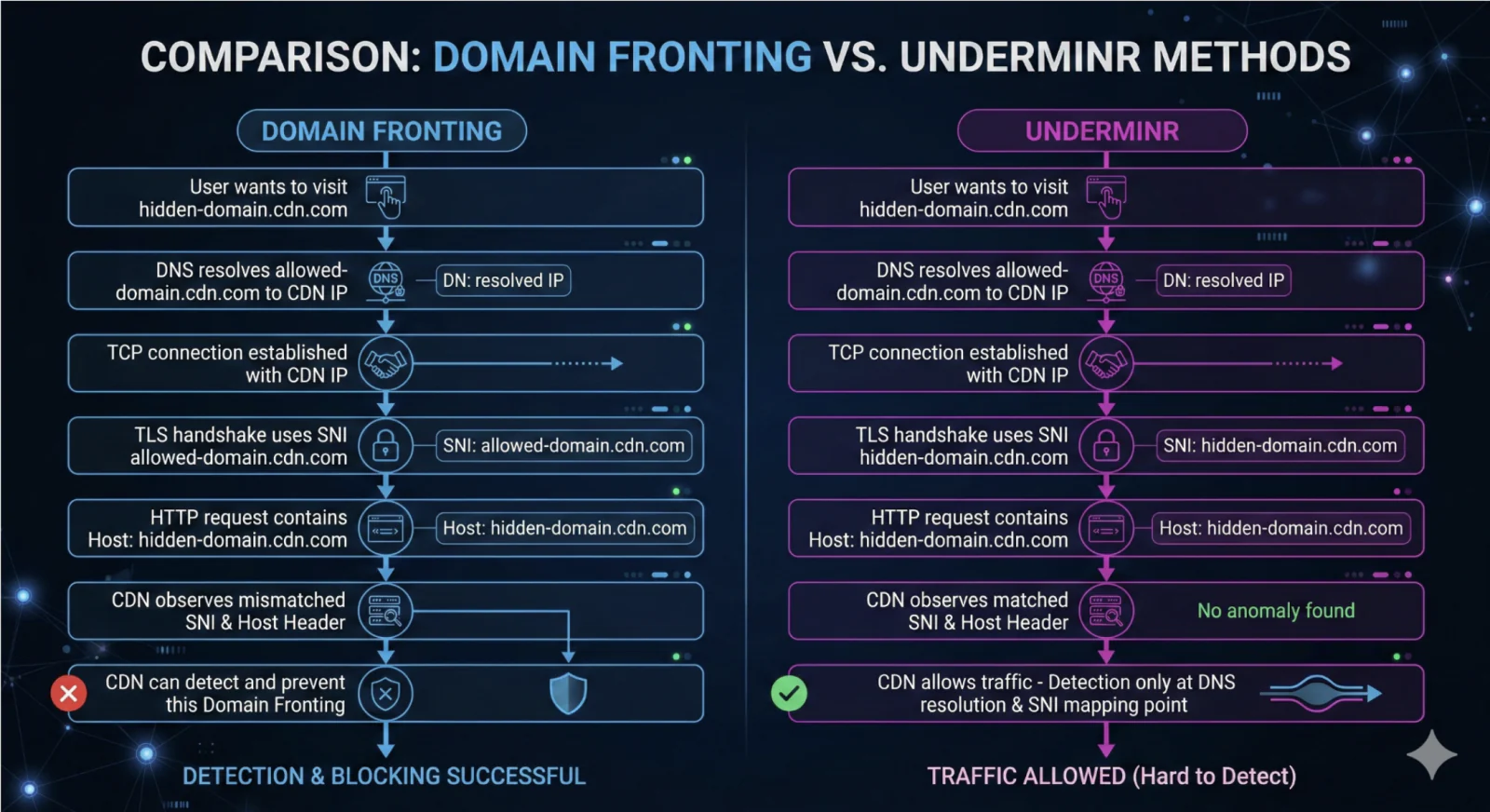
Underminr circumvention differs from legacy Domain Fronting by forcing a request to the IP address resolved for one domain while presenting the SNI and HTTP Host of another tenant on the same shared edge. The operative mismatch is between the DNS-resolved destination and the hostname the edge actually routes:
| Protocol Layer | Domain Fronting (domain used) | Underminr (domain used) |
|---|---|---|
| DNS | allowed-domain.cdn.com | allowed-domain.cdn.com |
| SNI | allowed-domain.cdn.com | hidden-domain.cdn.com |
| HTTP Host Header | hidden-domain.cdn.com | hidden-domain.cdn.com |
Observed abuse
ADAMnetworks has observed this pattern in recovered abuse configurations: an allowed domain is resolved first, then the client completes a connection to a different hosted domain through SNI or Host routing on shared CDN infrastructure. That evidence supports observed abuse of the method, separate from the Tranco population used to measure vulnerable domains.
Underminr TTPs
While measures taken by CDNs have made domain-fronting mostly ineffective today, the Underminr vulnerability leverages four distinct strategies to circumvent PDNS as a security layer.
The attack is launched by a malicious application or even a simple shell script on an endpoint that is within a secured network. This could include (but is not limited to):
- User sanctioned application for purposeful circumvention
- Clickfix attack (user is social engineered to paste a script and run it on their endpoint)
- Intentional Malware
By utilizing any single method, or a strategic combination of the following 4 Underminr methods the adversarial application can adapt to effectively defeat any of the following security configurations:
Simple Mode
Endpoint is protected by PDNS and DNS enforcement
Split Mode
Endpoint is protected by PDNS of resolving domain + Deep Packet Inspection (DPI) SNI check on first packet of a flow
ECH Mode
Endpoint is protected by SNI DPI only without PDNS detection
Direct-to-IP Mode
Endpoint relies on PDNS only without a DNS enforcement element or relying on blocklisting malicious IPs
Most examples use TCP port 443 because SNI exposes the intended TLS hostname. Recovered abuse material also shows TCP port 80 variants where HTTP Host or injected HTTP headers provide the deceptive destination. Other ports require protocol-specific routing or identity fields and should be treated as separate test cases.
An example of how easily a threat is deployed at a deceptive, hidden proxy can be found in SoftEtherVPN. This approach is used in Flax Typhoon, China-aligned APT and related groups (e.g., Webworm, GALLIUM, MirrorFace, ToddyCat).
These techniques align with MITRE ATT&CK T1133 (External Remote Services) and T1572 (Protocol Tunneling), where the VPN tunnel itself provides encryption plus protocol masquerading to defeat signature- and behavior-based detection. In all cases, the masking enables both long-term undetected presence and bulk or targeted data exfiltration and are increasingly replacing traditional RATs for long-term stealth.
Let's explore the various modes.
1. Simple Mode
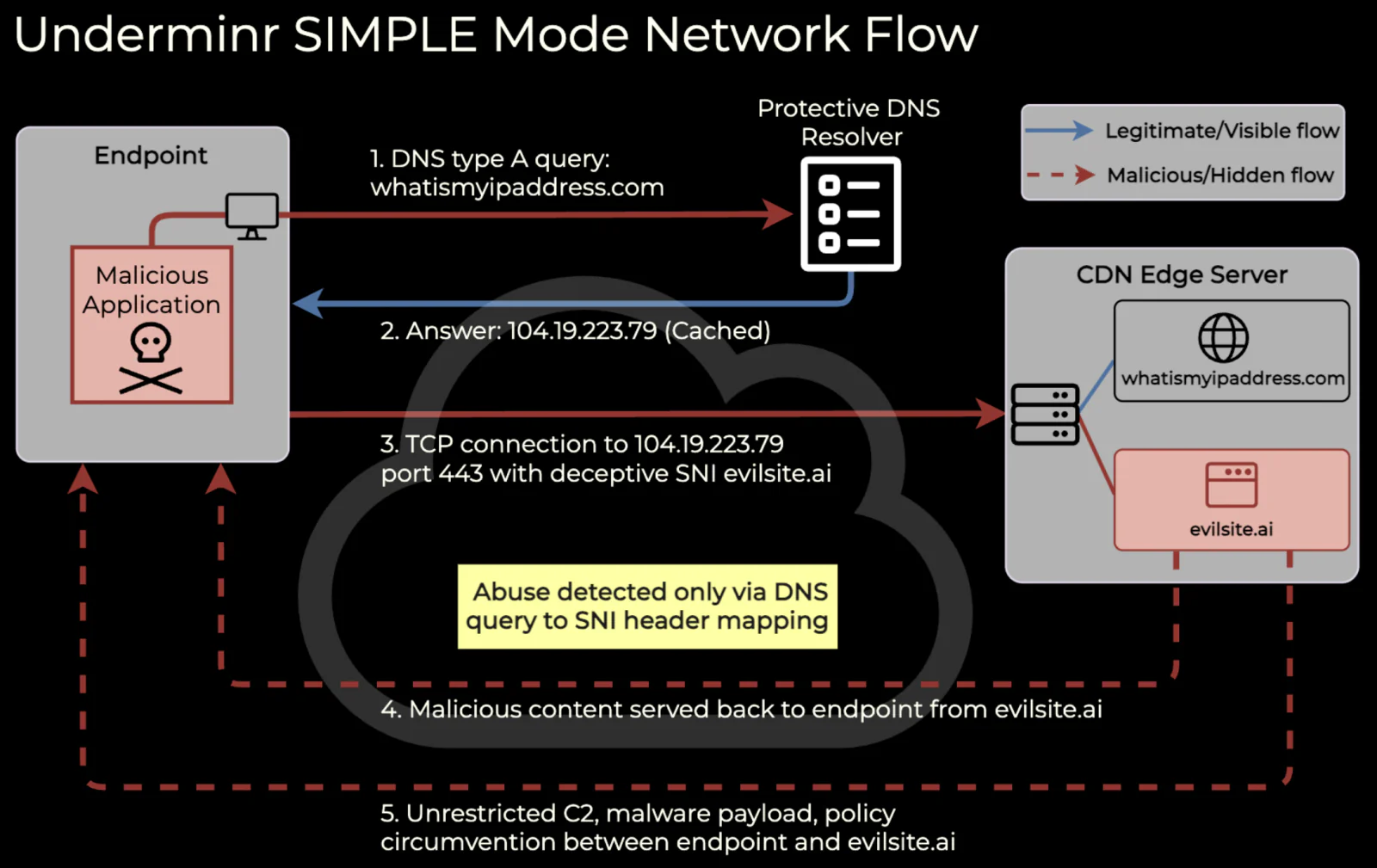
With this approach, detection depends on correlating the DNS answer for the allowed domain with the later connection tuple: destination IP, SNI, Host header, and timing.
- Malicious Application on Endpoint does a DNS type A query for whatismyipaddress.com
- Answer returned protective DNS resolver and cached as 104.19.223.79
- Malicious Application on Endpoint makes TCP connection to 104.19.223.79 port 443 but uses a deceptive SNI of evilsite.ai which is also hosted & accepted by the same CDN.
- Malicious content is served back to endpoint from evilsite.ai
- Unrestricted connectivity for C2, malware payload. Policy circumvention etc between endpoint and server at evilsite.ai
Sample
REDACTED FOR SECURITY UNTIL PUBLIC RELEASE
Video Recording of application using Underminr Simple Mode [REDACTED FOR SECURITY UNTIL PUBLIC RELEASE]
2. Split Mode
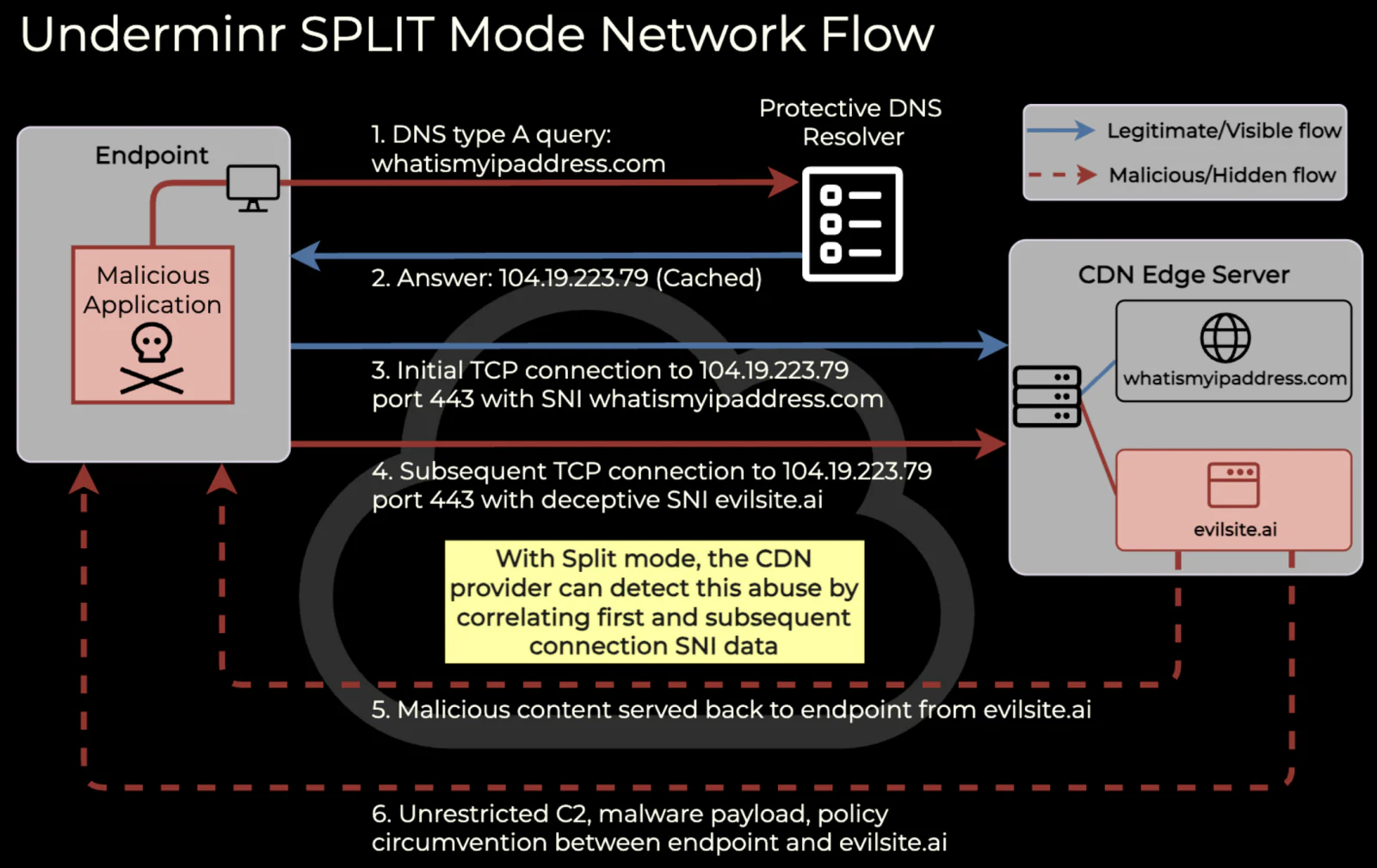
In split mode, the client first opens a TLS connection using the trusted SNI to satisfy first-packet SNI inspection. It then opens a subsequent connection to the same CDN edge IP using the deceptive SNI:
- Malicious Application on Endpoint does a DNS type A query for whatismyipaddress.com
- Answer returned protective DNS resolver and cached as 104.19.223.79
- Malicious Application on Endpoint makes TCP connection to 104.19.223.79 port 443 but uses the SNI of whatismyipaddress.com which passes DPI that does first-packet-only check
- Malicious Application makes subsequent TCP connection to 104.19.223.79 port 443 but substitutes a deceptive SNI of evilsite.ai which is also hosted & accepted by the same CDN
- Malicious content is served back to endpoint from evilsite.ai
- Unrestricted connectivity for C2, malware payload or policy circumvention etc. between endpoint and server at evilsite.ai
With Split mode, the CDN provider could potentially detect this abuse.
Sample
REDACTED FOR SECURITY UNTIL PUBLIC RELEASE
3. ECH Mode
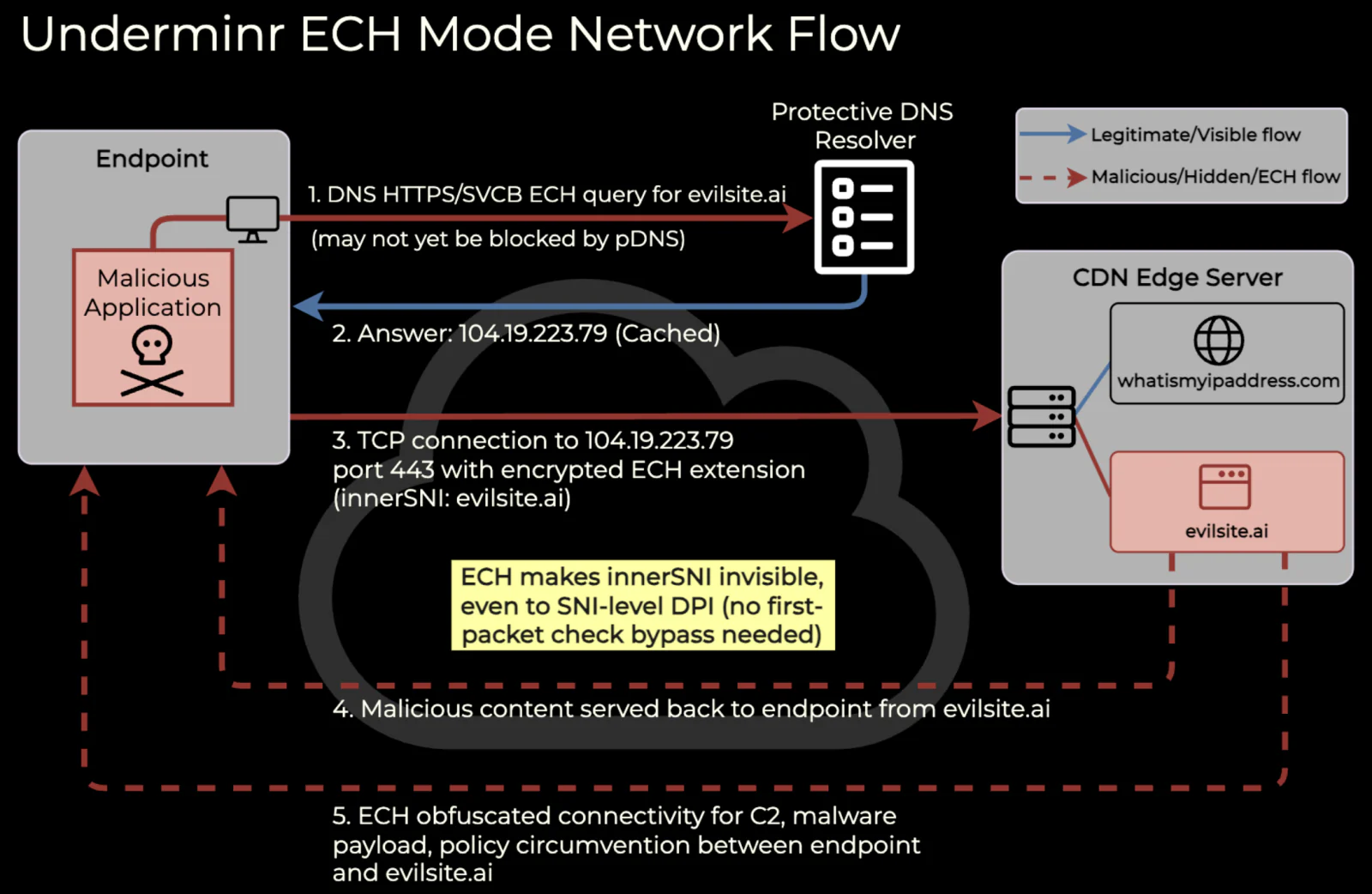
In traditional Deep Packet Inspection (DPI), the SNI header is used to identify the hostname in clear text without decrypting the TLS payload. ECH is not a DNS bypass by itself. Its effect is narrower: it removes the inner SNI from passive network inspection. If a DNS event is allowed, missed, or obtained outside the approved resolver path, defenders cannot rely on visible SNI to verify that the resolved name and final TLS destination still match.
- The client obtains an HTTPS/SVCB answer containing ECH configuration for a name that is allowed, uncategorized, or obtained outside the approved resolver path.
- The client connects to the returned CDN edge IP.
- The outer ClientHello exposes the ECH public name, while the inner SNI carrying the effective destination is encrypted.
- If controls depend on cleartext SNI, they cannot compare the resolved name to the effective TLS destination.
- The connection can then proceed without exposing the inner SNI to passive inspection.
Sample
https://boikng\.com/
This is a ClickFix attack that leads to this command where bkwwd\.com makes use of Encrypted Client Hello (ECH):
REDACTED FOR SECURITY UNTIL PUBLIC RELEASE
4. Direct to IP Mode
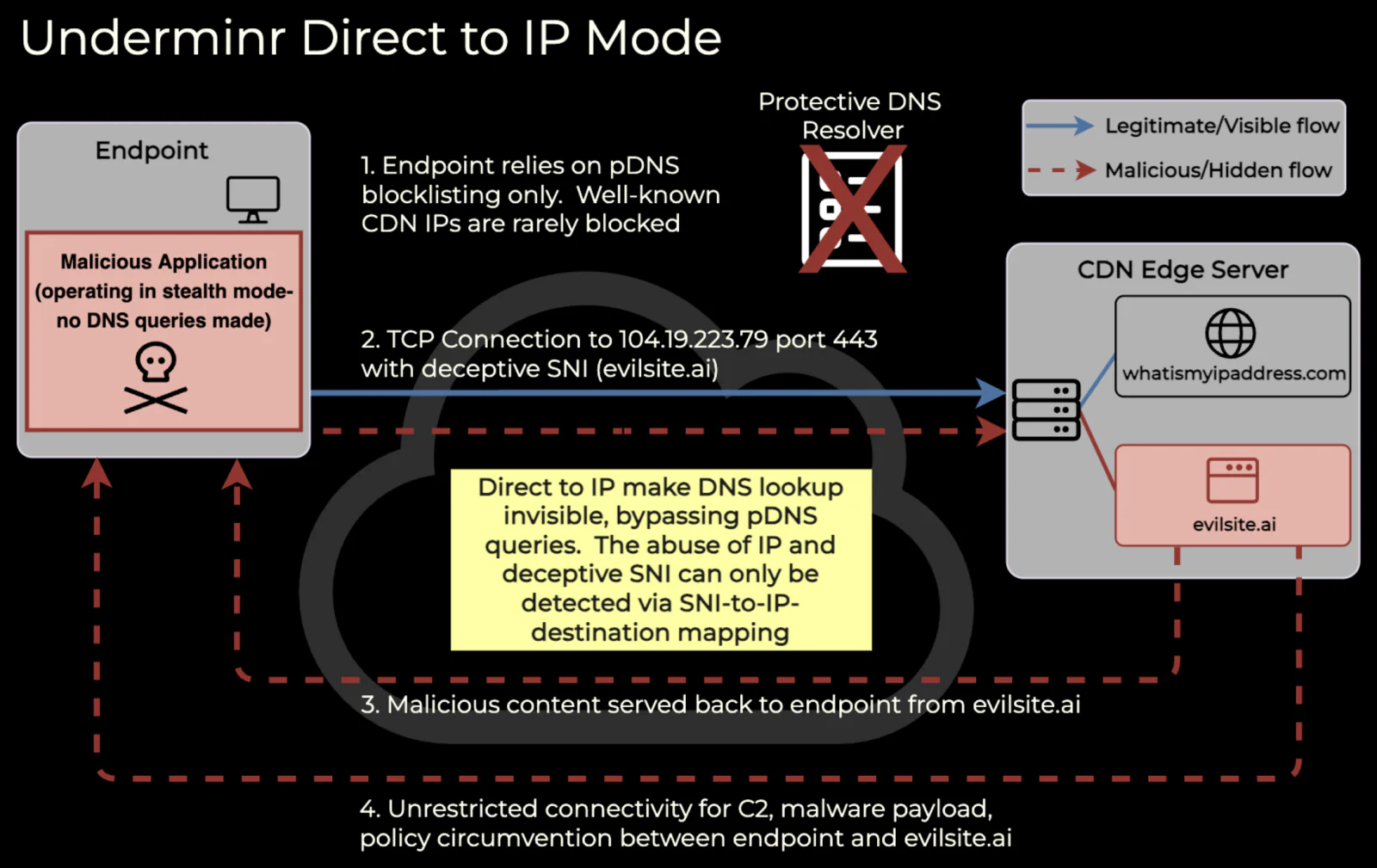
This is useful to the adversary when the endpoint relies on PDNS only without a DNS enforcement element (ZT DNS or DTTS) but relying on blocklisting malicious IPs (well-used CDN IPs are rarely blocked). This mode targets environments where DNS policy exists but clients can still connect directly to IP addresses. No resolver event is created for the hidden destination; detection depends on identifying CDN-edge connections whose SNI or Host value is not backed by a recent allowed DNS resolution.
- Malicious Application on Endpoint operates in stealth mode because it never makes a DNS query visible to the PDNS resolver
- Malicious Application on Endpoint makes TCP connection to 104.19.223.79 port 443 but uses a deceptive SNI of evilsite.ai which is also hosted & accepted by the same CDN.
- Malicious content is served back to endpoint from evilsite.ai
- Unrestricted connectivity for C2, malware payload. Policy circumvention etc between endpoint and server at evilsite.ai
Sample
REDACTED FOR SECURITY UNTIL PUBLIC RELEASE
In this method, there will be no DNS telemetry of evilsite.ai at all.
Impact
Defenders
The greatly enhanced risks of adversaries defeating hardened security stacks to restore a true proactive security posture. Network defenders of mission-critical operations will be forced to deny access to domains that could be abused as part of Underminr circumvention attacks.
Domain owners - your reputation is your neighbours’
A domain may be exposed when its DNS answer points at shared CDN infrastructure that also accepts SNI or Host values for other customer domains on the same edge IP.
Content Delivery Networks
The risk exists when a CDN or reverse proxy allows cross-tenant routing on shared edge IPs without binding the requested SNI or Host value to the domain or account that supplied the IP path.
Defense Technology Providers
For those that choose to honour Sovereign Data Custody - i.e. without any third-party TLS termination - this has the ability to circumvent PDNS filtering if the stack does not also include additional technology elements that can neutralize Underminr circumvention.
Why and how is Protective DNS affected?
DNS-based filtering is an important foundational element of any security stack. Known-good domains can be resolved, while known-malicious domains are blocked. However, when a threat can mask behind a known-good domain, this protection layer by itself can no longer offer the intended protection.
Mitigation
By Technology Providers
Shared Threat Intelligence Feed
A threat intelligence sharing service will be stewarded by ADAMnetworks and will be available to select interested parties in intelligence sharing to allow defenders to mitigate the vulnerability. To express interest, visit https://adamnet.works/contact/.
Link to Intelligence Share Specifications →Online Tool: Have I Been Undermined
An online tool on a website (similar to https://haveibeenpwned.com) allows domain owners to check whether their domain returns a positive Underminr provider test result and whether it also appears in the known abused list. The site also provides technical background on the issue and mitigation options.
Colour Green – e.g. adamnet.works
Current provider-specific checks did not produce a positive Underminr result for this domain.
Colour Yellow - e.g. example.com
Domain is vulnerable under the current provider test path, but does not appear in the known abused list
Colour Red - e.g. zopim.com
Domain is vulnerable and appears in the known abused list.
Block list
Will not be displayed - these are domains that are hidden behind the "red" domains (domains that Underminrs are connecting to), but will be available as an intelligence feed.
By Domain Owners
Network defenders of mission-critical operations will be forced to deny access to domains that could be abused as part of Underminr circumvention attacks. This will deny access to legitimate use of such trusted domains and erode the reputation of these domains.
The abuse of trust for well-recognized domains will harm brand reputation for brand owners.
DNS resolution forensics that are done post breach that used an Underminr attack as part of the attack chain will name the trusted domain as part of the attack.
Inspecting an owned domain on the Online Application https://underminr.ai will yield one of the following 3 results in public view:
- Green: The current public check did not return a positive Underminr result for the domain.
- Yellow: The domain returned a positive Underminr test result, but is not in the known abused list.
- Red: The domain returned a positive Underminr test result and is in the known abused list.
If their website is in the yellow or red list, as a domain owner, you have the option of either:
- have the CDN operator remove the vulnerability
- move the web/app hosting to another environment
By Network Defenders
The focus on this section is for Sovereign Data Custody environments, expecting a strong security posture regarding egress control without the use of a proxy.
-
1. Designate a network tapMonitor for connections to CDN or shared-hosting IPs
where the SNI or Host value is absent from the
approved resolver cache, differs from the resolved
domain, or appears outside the approved DNS path. For
the benefit of the entire industry, ADAMnetworks is
offering a tool and data exchange protocol to identify
domain names that are being used by underminers as
well as actual threat connections. This allows
participants to make decisions on how to maximize the
practicality of such rules. To use the example above,
the tool produces two lists:
Resolved Domains
e.g.: whatismyipaddress.com
Deceptive Destinations
e.g.: evilsite.ai
- 2. Treat resolved domains and deceptive destinations separatelyUse the resolved-domain list to identify domains being used as the allowed DNS path. Use SNI or Host inspection to identify deceptive destination domains. These are different artifacts and should not be collapsed into one blocklist.
- 3. Strip ECHStrip ECH from domain HTTPS and SVCB answers.
-
4. Block known ECH SNI domainsIn the event the ECH key is obtained elsewhere then
designated DNS server, block connections to known SNI
domains used for ECH (e.g.
cloudflare-ech.com).
Looking forward
IPv4 address exhaustion is real. This makes it impossible for CDNs to offer dedicated addresses per public service. IPv6-only services that are public-facing are also impractical. Realistically, CDNs will need to offer packages that segment a customer based on risk factors (as Fastly, for example, already does), and perhaps this will be the motivation required to make it more difficult for adversaries to hide behind modern-day CDNs and web application firewalls/reverse proxies.
Future Impact if left unmitigated
- •Adversaries have greatly enhanced circumvention capability and detection evasion capability against defenders.
- •Adversarial AI campaigns could abuse this exploit at scale. Once the method becomes unleashed as part of AI-generated campaigns, it could overwhelm defenses worldwide.
- •DNS, a fundamental building block of internet communications, could lose significant ground as a practical security element. This, in turn, would significantly reduce the perceived value of PDNS as a security element and, as a cascading result, degrade the value of preemptive defense security intelligence.
- All of the above would be a huge step backwards for the entire security industry and for defenders safeguarding the internet as a whole.
Contact
For further technical details, media inquiries, or to discuss mitigation strategies, please reach out to our team.
Contact usSource Code Access
The proof-of-concept exploit code and detailed scanning methodology have been intentionally withheld from public disclosure for security reasons. We adhere to responsible disclosure practices to prevent active exploitation of vulnerable domains before organizations have time to remediate.
Additional access to technical indicators, source code, and scanning infrastructure can be requested by verified security researchers, academic institutions, and network partners.